Am I balding?
Hair miniaturization: the earliest sign of male pattern baldness
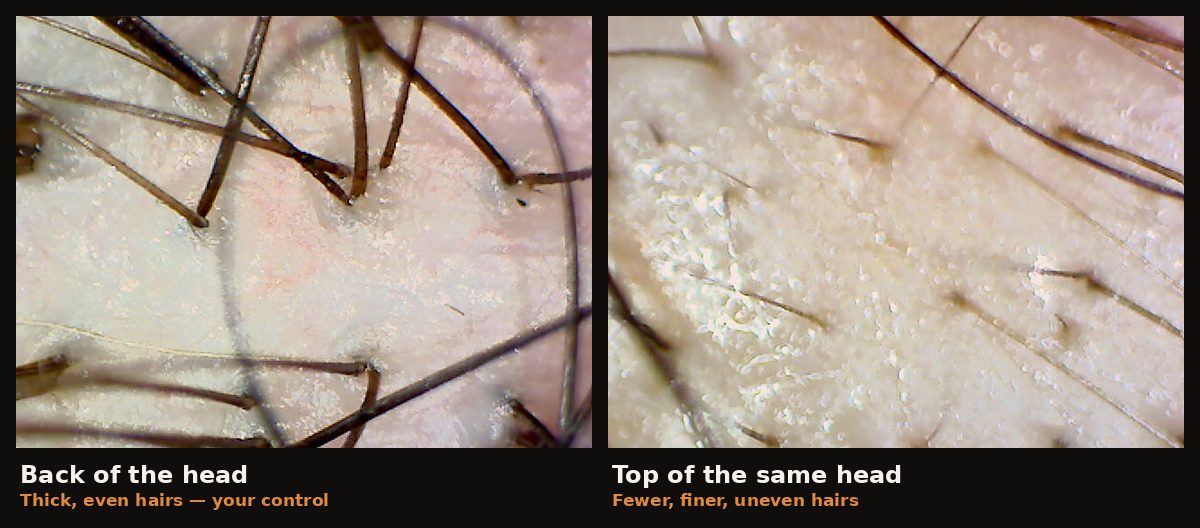
Miniaturization is how pattern hair loss begins: with each growth cycle, sensitive follicles produce a thinner, shorter hair than the last, until some barely make it past the skin. It happens long before an area looks thin, because a zone can lose a lot of hair volume while keeping its hair count. Dermatologists diagnose pattern loss by spotting it under magnification: a wide spread of hair thicknesses, and finer hair on top than at the back of the head.
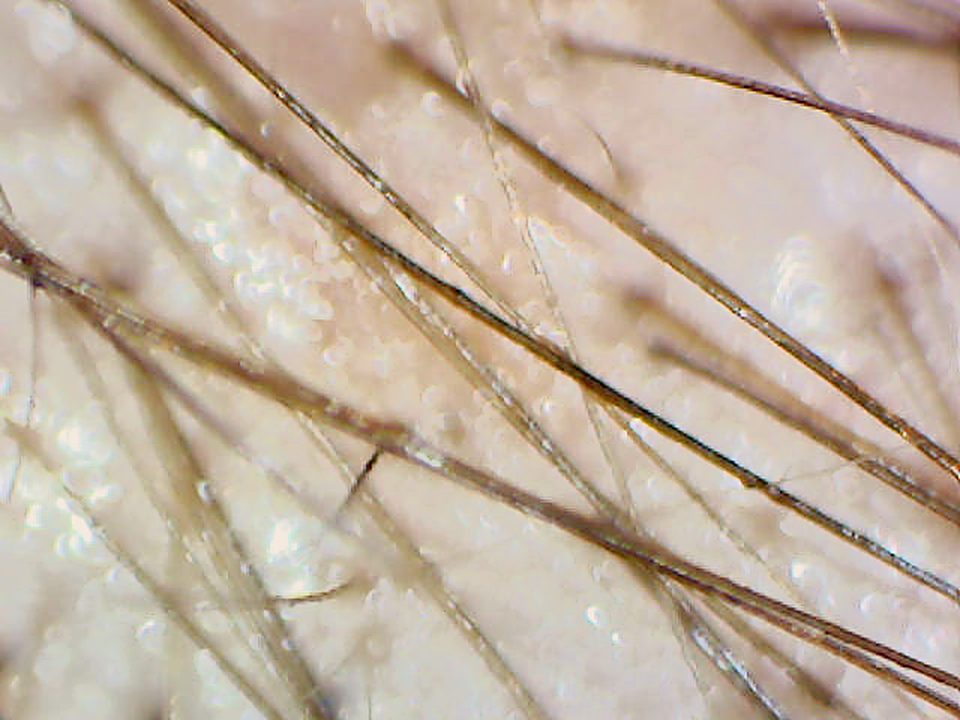
What miniaturization is
Each scalp follicle cycles: it grows a hair for years, rests, sheds it, and starts again. In pattern hair loss, follicles on the top of the head that are sensitive to the hormone DHT shrink a little with each cycle. The hair they produce gets:
- Thinner, the first and most measurable change;
- Shorter, because the growing phase shortens;
- Lighter, eventually becoming fine, pale “vellus” hairs, like peach fuzz.
Over enough cycles, some follicles stop producing visible hair at all. The hair at the back and sides is usually resistant, which is why it stays, and why it makes a useful control for comparison.
Why you can’t see it in a mirror
Coverage depends on the cross-section of each hair, which scales with the square of its width. A hair that’s 20% thinner covers about 36% less scalp, but a mirror shows you a head of hair that’s still all there. Many hairs can shrink substantially before you notice anything; by the time a zone looks thin, miniaturization has usually been going on for years. Lighting and photos make it harder still (why progress photos lie).
How dermatologists measure it
Dermatologists use trichoscopy, a magnified scalp exam. Published diagnostic criteria for pattern hair loss include:1
- Hair diameter diversity: more than 20% of hairs thinner than normal terminal hairs.
- Finer hair on top than at the back: lower average thickness in the front than at the occiput.
- Thin and vellus hairs: more than 10% thin hairs (under 0.03 mm) at the front, and a higher share of vellus hairs at the front than the back.
- Yellow dots: empty follicle openings.
Notice that the criteria compare you with yourself: the front against the back, and the spread of thicknesses within a zone. That’s more reliable than any single number, because normal hair thickness varies a lot between people.
What it means for treatment
A miniaturized hair is still a living follicle, and that’s the window treatments work in. Medicines like finasteride and minoxidil aim to slow or partly reverse miniaturization; they generally can’t revive follicles that are long gone. So the earlier miniaturization is caught, the more there is to protect. A dermatologist can confirm what’s going on and discuss options; measuring before treatment gives you a baseline to judge it by.
See miniaturization before the mirror does
GraftReport measures hair thickness in each zone against your own control at the back of your head, plus how mixed each zone has become: the same comparison dermatologists use.
Get the kit — $199How the balding check worksCommon questions
What is hair miniaturization?
It is the gradual shrinking of hair follicles in pattern hair loss. With each growth cycle the hair grows back thinner, shorter and lighter, until some follicles produce only fine vellus hairs or none.
How do you know if your hair is miniaturizing?
Under magnification, a miniaturizing area shows a wide spread of hair thicknesses and finer hair than at the back of the head. Published criteria include more than 20% of hairs being thinner than normal.
Can miniaturized hair be reversed?
Partly, in some people. Treatments such as finasteride and minoxidil aim to slow or reverse miniaturization while follicles are still alive, which is why acting early matters.
Why does hair look fine even when it is miniaturizing?
Because the number of hairs can stay similar while each one gets thinner. A hair 20% thinner covers about 36% less scalp, but the change is gradual and hard to see until it is advanced.
Sources
- Rakowska A et al. Dermoscopy in female androgenic alopecia: method standardization and diagnostic criteria. Int J Trichology. 2009;1(2):123–130. Criteria summarized at dermoscopedia.org
This guide is general information, not medical advice. Hair loss has many causes; see a dermatologist for sudden, patchy or painful hair loss, or before starting or stopping any medication.