Am I balding?
What is hair shaft diameter, and why does it matter for hair loss?
Hair shaft diameter, or caliber, is how thick each individual hair is, measured in micrometers (µm). Healthy scalp hairs are often somewhere around 60–100 µm, while very fine vellus hairs are under 30 µm. It matters because coverage scales with the square of thickness: a hair 20% thinner covers about 36% less scalp. In pattern hair loss, diameter drops before hair count does, which makes it the earliest measurable sign.
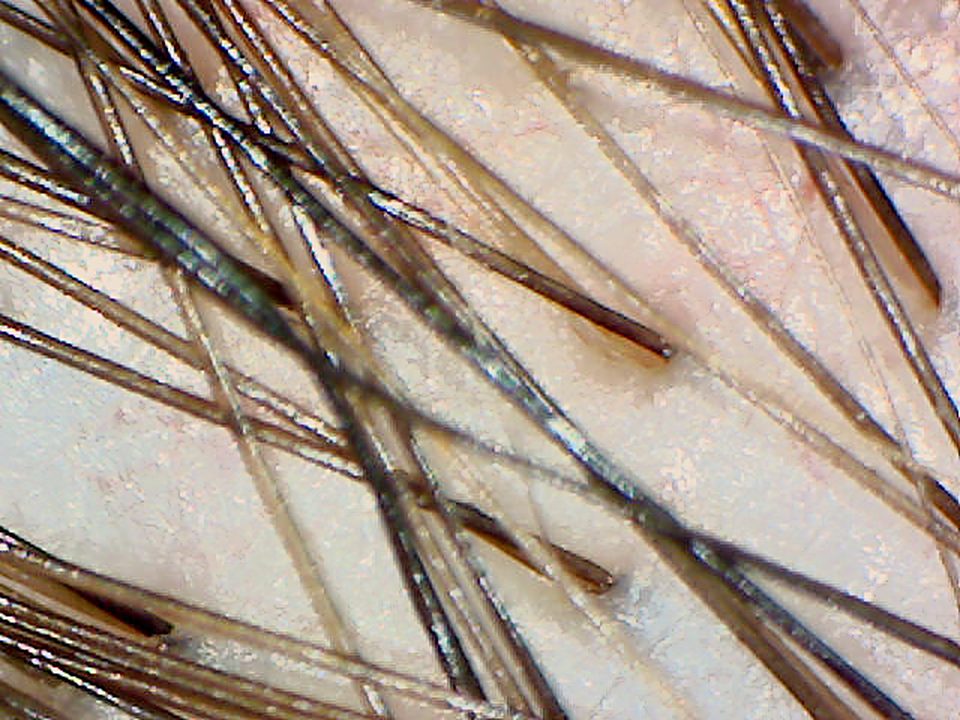
What hair diameter is
Each hair is a thin fiber whose width varies from person to person and from hair to hair. Hair loss specialists call it caliber. Together with the number of hairs, it decides how full your hair looks: many thick hairs cover the scalp well; the same number of fine hairs doesn’t.
Typical ranges
| Hair type | Approximate diameter |
|---|---|
| Terminal scalp hair (full thickness) | Often around 60–100 µm; varies a lot by person and ethnicity |
| Thin, miniaturizing hair | In between, drifting down over cycles |
| Vellus hair (fine “peach fuzz”) | Under about 30 µm (0.03 mm) |
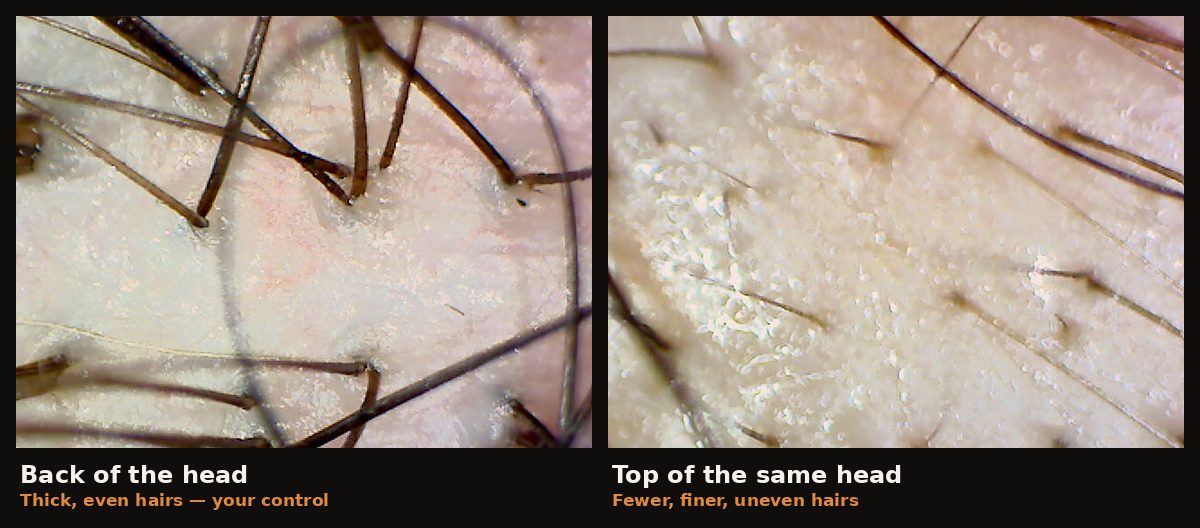
Because normal thickness varies so much between people, a single number on its own says little. Diagnostic criteria for pattern loss compare hair on top with hair at the back of the same head, and look at how varied the thicknesses are within a zone.1
Why small changes matter
The scalp a hair covers depends on its cross-section, which grows with the square of its width:
| Hair gets thinner by | Coverage drops by about |
|---|---|
| 10% | 19% |
| 20% | 36% |
| 30% | 51% |
| 50% | 75% |
That’s why hair can look noticeably thinner even when you’re not losing many hairs: each one is quietly shrinking. It also means treatment progress shows up in diameter first; a few micrometers of thickening across a zone adds real coverage.
How it’s measured
- Micrometer or microscope: a plucked or cut hair measured precisely. Accurate for that hair, but it’s one hair, and it’s gone.
- Trichoscopy: a dermatologist’s magnified scalp exam, judging the mix of hair thicknesses in a zone.1
- Calibrated magnification at home: a scanner with a known scale measures many hairs in place, zone by zone. Because the same method is used on every zone, the ratio between a thinning zone and your control area is more reliable than any absolute number, and it’s what tells you whether hair is changing.
Measure your hair’s caliber, zone by zone
GraftReport uses a calibrated 50× scanner to estimate hair thickness across each zone and compares it with your own control at the back of your head.
Get the kit — $199How the balding check worksCommon questions
What is a normal hair diameter?
Full-thickness scalp hairs are often around 60 to 100 micrometers, but it varies widely between people. Very fine vellus hairs are under about 30 micrometers.
Why does hair thickness matter for hair loss?
Coverage depends on the cross-section of each hair, which scales with the square of its width. A hair 20% thinner covers about 36% less scalp, so thinning hairs reduce fullness even before any are lost.
How is hair diameter measured?
With a micrometer or microscope on a single plucked hair, by a dermatologist using magnified scalp examination, or at home with a calibrated magnifying scanner that measures many hairs in place.
Can hair diameter increase with treatment?
Yes. Treatments for pattern hair loss aim to stop or partly reverse miniaturization, so increased hair thickness is often one of the first measurable signs a treatment is working.
Sources
- Rakowska A et al. Dermoscopy in female androgenic alopecia: method standardization and diagnostic criteria. Int J Trichology. 2009;1(2):123–130. Criteria summarized at dermoscopedia.org
This guide is general information, not medical advice. Hair loss has many causes; see a dermatologist for sudden, patchy or painful hair loss, or before starting or stopping any medication.