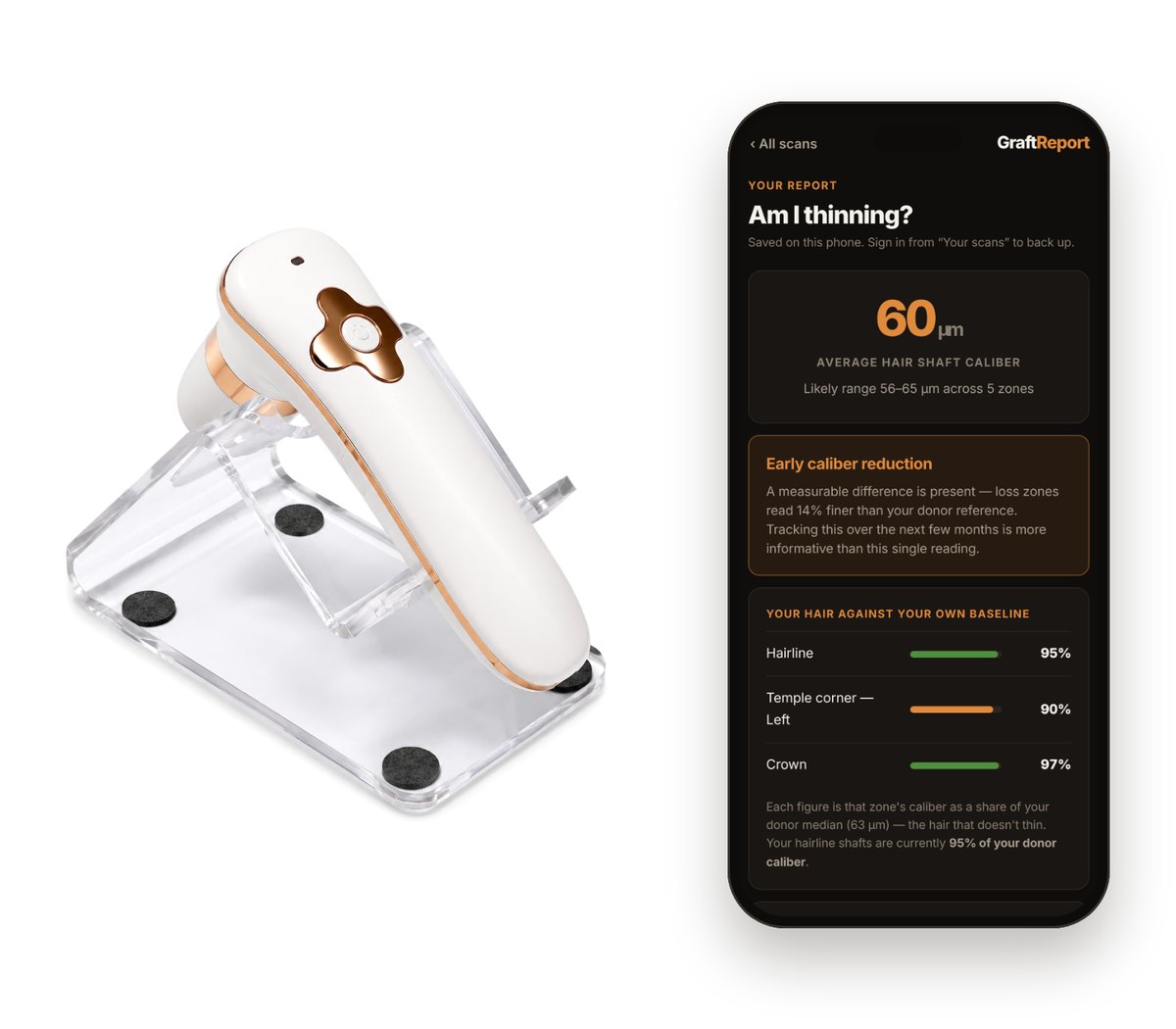
 The GraftReport Kit — scanner + app
Know before you go
Your hair loss, in numbers instead of guesses.
A $6K–$25K decision — or three years on a daily medication — deserves more than a bathroom mirror and a bad feeling.

What it's for
One scanner. Three questions.
The measurement is identical. What changes is what you're asking it.
Is the minoxidil doing anything, or are you three months into nothing?
Measure before you start, then every 30 days. Watch shaft thickness move instead of reading the shower drain for omens.
Am I losing hair, or imagining it?
One session, no waiting. The hair on the back of your head doesn't thin — so it becomes the control your thinning hair is measured against.
Do I have the donor supply for a transplant?
An independent read on your donor area before you book a flight and hand over a deposit.
The report is the product
Stop guessing whether your treatment is working. Measure it.
The scanner collects the frames. The report turns them into answers: how much of your hair is thinning, how far along it is, and what your donor area can realistically supply.


Join the scanner’s Wi-Fi and see your scalp live on your phone.
A 30-second check that you’re parting the hair enough for a clean read.
About 10 seconds per zone. Your donor hair becomes your personal baseline.
Back on normal Wi-Fi, an AI pass counts where each hair leaves the skin.
Fixed, published rules turn the measurements into your verdict. Rescan to track change.
Sample cards from a founder’s scan; follicle counts shown are illustrative while the counting model is validated. Works best on dark and medium-brown hair. Very light, blonde or grey hair gives the scanner less contrast against the scalp, and the report tells you when that affects accuracy. Informational measurement, not a diagnosis.
ILLUSTRATIVE EXAMPLE
The mirror looks the same. The measurement doesn't.
Hair shaft caliber changes months before coverage looks any different. That's the window a scan can see and a photo can't.
 DAY 0
DAY 90
SCAN
Sweep the zone with the 50× scanner.
MEASURE
Shaft caliber in microns, calibrated.
TRACK
Watch the number move over months.
HAIR SHAFT CALIBER
Same zone. Same measurement.
Different signal.
The process
Box to answer in about ten minutes.
Connect
The scanner broadcasts its own Wi-Fi. Join it from your phone and open the app in your browser. Nothing to install.
Sweep each zone
On-screen prompts show placement. Hold it to your scalp and move slowly for about ten seconds while it captures.
Read your report
Shaft caliber, the share of hairs thinning, and how your loss zones compare to hair that never thins — every figure as a range.
Scan again whenever
You keep the scanner. Later scans line up against your first, because magnification is fixed and every unit ships calibrated.
Where it leads
A result that points somewhere, not just a number.
Not everyone needs surgery, and not everyone's ready for it. The report is built to tell you which is true for you.
If the numbers don't support surgery yet, medication is usually the sensible first move. Slowing loss now means more options later.
- A straight read on whether treatment is worth exploring
- A Day 0 baseline, so you can tell later whether it worked
- Telehealth partners — in development
If your donor supply supports it, your report becomes the opening of a real consultation instead of a cold sales conversation.
- A measured report you can bring to any clinic
- Donor edges checked for thinning that shrinks usable supply
- Vetted clinic network — in development
On precision
Every number is a range. On purpose.
Hair measurement carries real variance, and a tool that hides it is selling confidence it doesn't have. Your report plots each scan as a range. When two scans overlap, it tells you the change isn't meaningful yet. It's a less exciting chart and a more honest one.
Be first to get one.
We're shipping a small first batch before public launch.
$199 for the scanner + app. Buy now, or leave your email for updates.