Tracking your hair
Why your hair loss progress photos lie (and what to measure instead)
Progress photos mostly measure your lighting, not your hair. Overhead light, wet or freshly washed hair, holding the phone closer, or a slightly different angle can make the same scalp look noticeably thinner or fuller. Photos also only show coverage, which changes late. To know whether your hair is really changing, measure the hairs themselves (their thickness and the share that are thinning) in the same spots each time, compared with the hair at the back of your head.
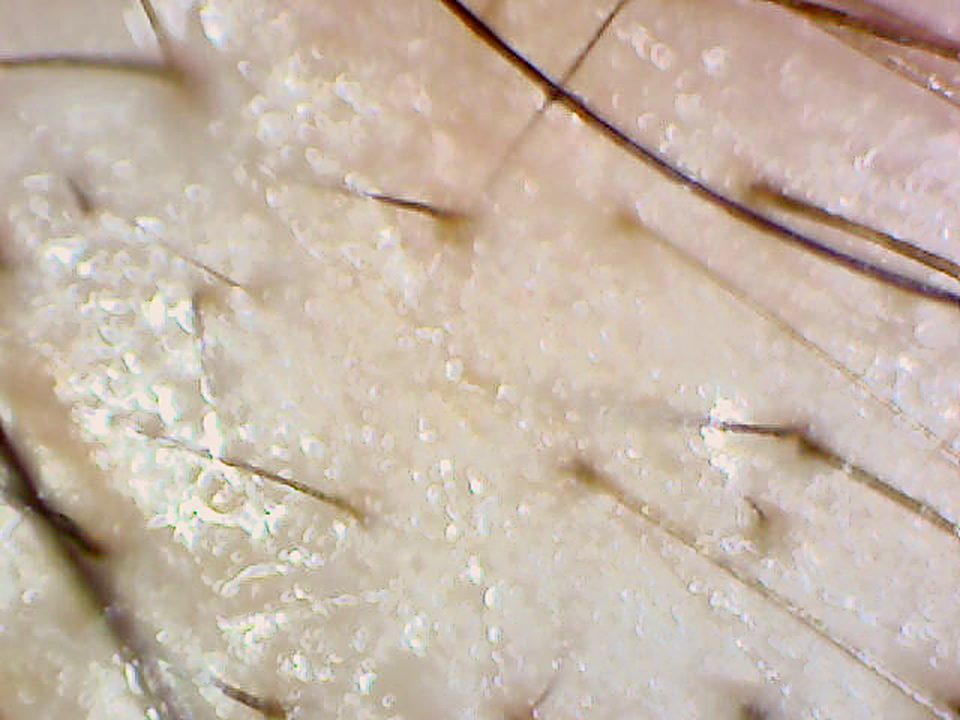
Why the same head looks different in every photo
If you’ve ever felt fine in the morning and panicked in an elevator mirror that afternoon, nothing changed but the light. Hair is semi-transparent and your scalp is reflective. Small changes in how you take a picture swing how much scalp shows through, often more than months of real change would.
| Makes hair look thinner | Makes hair look fuller |
|---|---|
| Overhead light (bathrooms, elevators, car sunroofs). It shines straight down through the hair and bounces off the scalp. | Soft light from the front or side, such as a window you’re facing. |
| Wet or freshly washed hair. Water clumps hairs into strands and opens gaps. | Dry, styled hair that spreads out and overlaps. |
| Phone close to your head. Wide phone lenses exaggerate whatever is nearest, usually your crown or part. | Phone further away, or a 2× lens setting. |
| Head tilted down, which opens your part and crown whorl. | Head level, hair falling naturally. |
| Bright auto-exposure, which washes fine hairs out of the image. | Darker exposure, where fine hairs still show up. |
| Oily hair on day three after washing, and shorter hair after a haircut. | Volumizing products, fibers, and longer hair. |
Stack two or three of these and the same scalp can look like two different stages of hair loss. That’s why comparing a random selfie from last year with one from today tells you almost nothing.
How to take consistent progress photos
If you’re going to take photos, control everything except your hair:
- Same place, same light. One room, one light source, the same time of day. A single lamp at night is more repeatable than a window, which changes with the weather.
- Same hair state. Dry, no products, the same number of days since washing.
- Same camera setup. Rear camera, 1× lens, portrait mode off. Prop the phone on a stand at a marked spot and use the timer, or have someone stand on a tape mark on the floor.
- Same angles. Front with hair pushed back, top-down, crown with your head level, and both temples.
- Same point in your haircut cycle. About the same number of days after a cut.
- Every 4–8 weeks, not every day. Hair changes over months. Checking daily mostly feeds anxiety.
Done well, this makes photos far more useful. It still doesn’t fix the bigger problem.
What photos can’t show you
Pattern hair loss doesn’t usually start with hairs disappearing. It starts with miniaturization: with each growth cycle, affected follicles produce a hair that is a little thinner and shorter than the last. A head of hair can keep looking full while more and more of its hairs quietly shrink. Hair restoration surgeons commonly say a large share of density, often estimated at around half, can go before thinning is obvious to the eye.
Treatment works in the same order, in reverse. Hairs get thicker before coverage visibly improves. So photos lag in both directions: they show loss late, and they show recovery late.
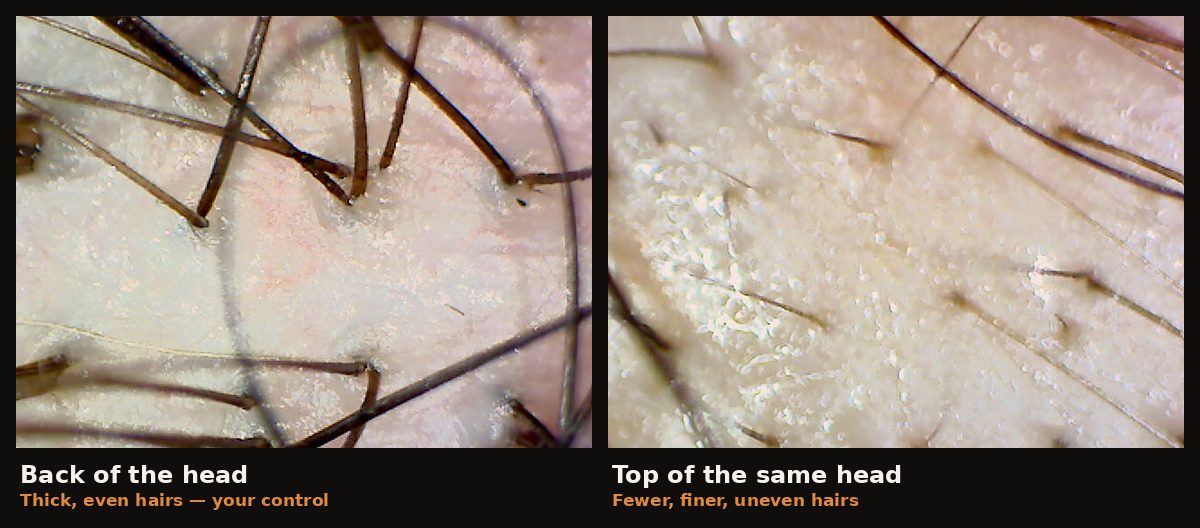
Dermatologists get around this with trichoscopy, a magnified exam of the scalp. Published criteria for pattern hair loss compare the hair on the front and top of the head against the back, look for a wide spread of hair thicknesses (more than 20% of hairs thinner than normal), and count very fine “vellus” hairs and empty follicles.1 None of that is visible in a selfie.
What to measure instead
The useful question isn’t “does it look thinner?” It’s “are the hairs in this spot thinner than they should be, and is that changing?” To answer it you need:
- Hair thickness compared with your own control. The back of your head (the lower crown) is the area pattern loss spares, so it shows what your hair is supposed to look like. A thinning zone shows up as a percentage of it.
- The share of thinning hairs in each zone. Pattern loss turns a zone into a mix of full and shrinking hairs. Naturally fine hair stays even.
- The same spots every time, so you’re comparing like with like.
- A measurement every 1–3 months, ideally starting before any new treatment, so you have a real baseline.
Numbers like these don’t care about bathroom lighting, wet hair or camera angles.
Measure the hair, not the lighting
GraftReport is a 50× scalp scanner and app. Sweep each zone for about ten seconds and get hair thickness compared with your own control area, the share of thinning hairs, and a trend every time you rescan.
Get the kit — $199How tracking worksCommon questions
Why does my hair look thinner in some lighting?
Overhead light shines down through your hair and reflects off your scalp, so more scalp shows. Soft light from the front or side hides the scalp. It is the same hair; the light changes how much scalp you see.
Why does my hair look thinner when it is wet?
Water makes hairs stick together into thicker strands, which opens gaps between them. Dry hair spreads out and covers more scalp. Wet hair looks thinner on almost everyone.
How often should I take hair loss progress photos?
Every 4 to 8 weeks is plenty. Hair grows and cycles over months, so daily or weekly photos mostly capture changes in lighting and styling, not real change.
What is the best lighting for hair progress photos?
The best lighting is the same lighting every time. A single lamp in the same spot at night is easy to repeat. Overhead light shows the worst case and soft front light the best; pick one and never mix them.
Can photos show if minoxidil or finasteride is working?
Eventually, but late. Treatments usually thicken existing hairs before coverage visibly improves, so photos often show nothing for the first 4 to 6 months. Measuring hair thickness shows the direction sooner.
Sources
- Rakowska A et al. Dermoscopy in female androgenic alopecia: method standardization and diagnostic criteria. Int J Trichology. 2009;1(2):123–130. Criteria summarized at dermoscopedia.org
This guide is general information, not medical advice. Hair loss has many causes; see a dermatologist for sudden, patchy or painful hair loss, or before starting or stopping any medication.