Hair transplants
How many grafts do I have? Estimating your donor supply
Your lifetime graft supply is roughly donor density × usable donor area × the share that can be safely removed. With a typical density of about 75 follicular units per cm², a usable area of 150–200 cm² and 25–35% safely extractable over a lifetime, that’s on the order of 2,800–5,250 grafts, or about 5,600–10,500 hairs at two hairs per graft. Your real number depends mostly on your density and on whether your donor area is truly permanent.
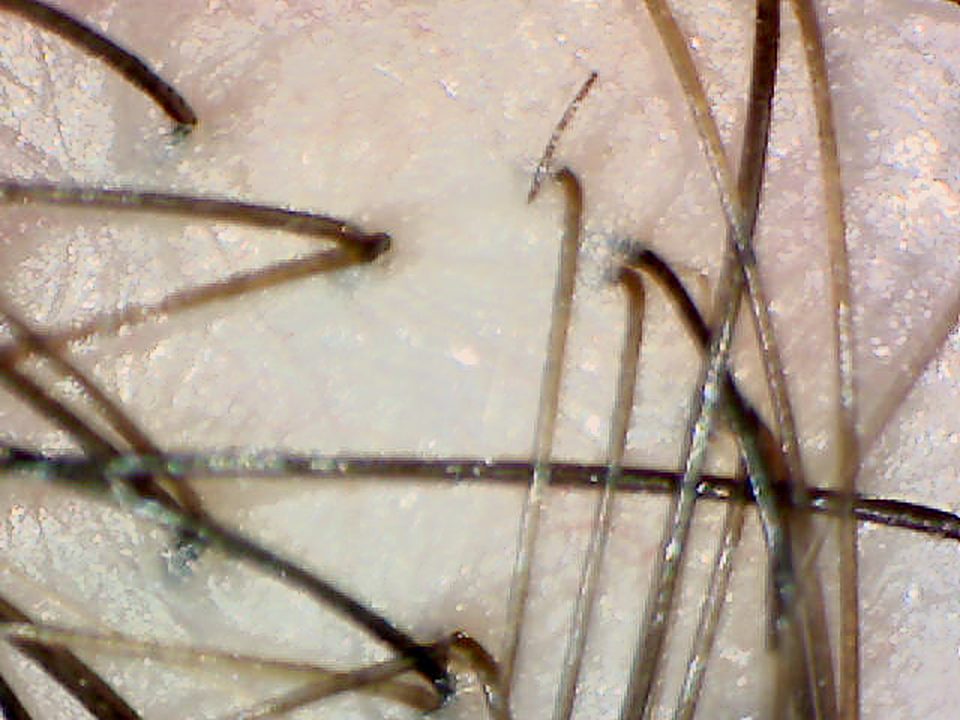
What a graft actually is
Hair grows in natural clusters called follicular units, usually one to four hairs that leave the skin through the same opening. A graft is one follicular unit moved from the donor area (the back and sides of your head) to a thinning area. So “3,000 grafts” isn’t 3,000 hairs; at a typical two hairs per graft, it’s about 6,000.
The donor supply formula
Surgeons estimate supply with three numbers:
- Donor density: follicular units per square centimeter at the back and sides. Commonly quoted typical values sit around 65–85.
- Usable donor area: the zone whose hair should stay put for life. It’s smaller than the whole back of the head; rough estimates are often around 150–200 cm², depending on head size and how far your hair loss pattern reaches.
- Safe extraction share: how much can be removed before the donor area itself looks thin. Surgeons are cautious here; one study suggested keeping FUE under 35% of density in a first session and 10–20% in a second.1 Lifetime estimates of 25–35% are a reasonable middle.
| Donor density (FU/cm²) | Estimated lifetime grafts |
|---|---|
| 55 (low) | about 2,050–3,850 |
| 75 (typical) | about 2,800–5,250 |
| 90 (high) | about 3,400–6,300 |
These are planning estimates using 150–200 cm² and 25–35%. A surgeon examining your scalp will refine every number.
Try it with your own numbers: the free graft calculator compares the grafts you’d likely need with what your donor area can likely supply.
What shrinks or stretches your supply
- Hair thickness. Thick hair covers far more scalp per graft. A hair 10% thinner has about 19% less cross-section, so fine hair needs more grafts for the same look.
- Hairs per graft. More two- and three-hair units means more coverage from the same graft count.
- Contrast and curl. Low contrast between hair and skin color, and wavy or curly hair, look fuller per graft.
- Donor thinning. If your “permanent” hair is itself thinning, the safe supply shrinks, sometimes to nothing. See donor area thinning (DUPA).
- Body hair. Beard and sometimes chest hair can add to the supply. See body hair transplants.
How to know your own numbers
Most people walk into a consultation knowing nothing about their own donor area. Two numbers change the conversation: how thick your donor hair is, and whether it’s even (pattern loss reaching the back of the head shows up as a growing mix of thin and thick hairs). Both are visible under magnification, and both are worth knowing before you’re quoted a graft count.
Know your donor area before the consult
GraftReport’s donor check measures hair thickness and evenness across your donor zones, and flags edges that are already thinning. Bring the report to your consultation.
Get the kit — $199How the donor check worksCommon questions
How many grafts can a person have in a lifetime?
It varies widely. With typical donor density (around 75 follicular units per cm²), a usable donor area of 150 to 200 cm² and 25 to 35% safely extractable, estimates land around 2,800 to 5,250 grafts. Higher donor density or added body hair can raise it; donor thinning lowers it.
How many hairs are in one graft?
Usually one to four, commonly averaging about two. A graft is one follicular unit, the natural cluster of hairs that share an opening in the skin.
What is a good donor density?
Commonly quoted typical values are around 65 to 85 follicular units per square centimeter. Below that, supply is tighter; above it, more grafts can be taken without visible thinning.
Can you run out of donor hair?
Yes. Donor hair is finite, and over-harvesting leaves the back of the head visibly thin. That is why surgeons plan for future loss and limit how much is taken.
Sources
- Ahmad M, Mohmand MH. Effect of follicular unit extraction on the donor area. World J Plast Surg. 2018. PMC6066700
- Bernstein Medical. Diffuse patterned and unpatterned hair loss. bernsteinmedical.com
This guide is general information, not medical advice. Hair loss has many causes; see a dermatologist for sudden, patchy or painful hair loss, or before starting or stopping any medication.